Monday, September 28, 2026

What Roman Heating and Cooling Really Cost — A History of Comfort: Rome, Part 4

Frontinus took charge of Rome’s water and discovered that the numbers did not add up.

That was a dangerous kind of problem in a city that liked to turn engineering into a monument. Nine aqueducts entered Rome by the end of the first century. Their water supplied public basins, fountains, baths, imperial properties, and a smaller number of private customers. Arches crossed the countryside as proof that Rome could make water obey.

The records said one thing. Frontinus’s measurements said another. Water entered the system and disappeared before it reached the people who were supposed to receive it.

Emperor Nerva had appointed Sextus Julius Frontinus as water commissioner in AD 97. Frontinus had already commanded an army in Britain, governed provinces, and served as consul. He could have treated this new office as one more honor at the end of an impressive career. Instead, he learned the system.

He studied the sources, lengths, elevations, channels, arches, reservoirs, pipe sizes, legal grants, and recorded deliveries. He had plans made so he could see the vulnerable parts of the network without standing beside every mile of it. He warned readers that some of his totals would be dry and complicated, then included them anyway.

Frontinus understood something Rome’s monuments tried to hide: a system is easiest to admire when you cannot see what it consumes.

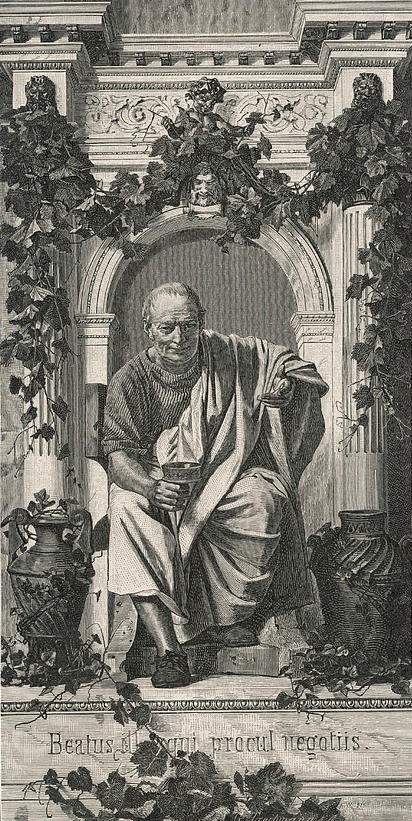
A later engraved portrait of Sextus Julius Frontinus

A 1788 portrait of Sextus Julius Frontinus—not a surviving likeness from his lifetime. Artist unknown. Wikimedia Commons, public domain.

The Water Had Been Stolen

Some losses were ordinary failures. Channels leaked. Concrete lining cracked. Mineral deposits hardened into crust and narrowed the passage. Tufa piers sometimes gave way beneath the weight above them. Tree roots forced apart the tops and sides of conduits. Other losses had help: Frontinus found farmers tapping aqueducts near their fields.

Inside Rome, unauthorized branches had been bored into buried pipes beneath the pavement. Water workers left old outlets in reservoirs after legal grants changed hands, then sold the extra water themselves. When Frontinus removed illicit connections, enough lead came back to give him a rough idea of how much theft had been hiding under the streets.

This was not one dramatic break that could be repaired and forgotten. Rome’s water was escaping through age, damage, favors, neglect, and a private market operating inside a public system.

Frontinus’s answer began with measurement. He compared what entered each line with what arrived at its reservoirs and what the records claimed should be delivered. Then he followed the discrepancies.

A complaint such as “we do not have enough water” had become a search for the missing volume, line by line.

Seven Hundred Men Behind the Water

Frontinus inherited two aqueduct workforces. One belonged to the state and numbered about 240 men. The other belonged to the emperor and numbered 460. All were enslaved.

The total is striking, but the job list matters more. Frontinus described overseers, reservoir keepers, inspectors, pavers, plasterers, and other workers. Some served outside the city along the aqueduct routes. Others stayed near urban reservoirs and fountains so they could respond when something failed and redirect reserve water toward the affected district.

Rome did not maintain its water with a handful of brilliant engineers. It maintained it with a large, specialized service organization whose workers had no freedom to leave it.

Frontinus also found that the crews had been diverted to private jobs through favoritism or careless supervision. He imposed a simple control: write down each crew’s assignment the day before, then record what it actually completed.

Those daily logs reveal both his competence and his position. We hear the manager deciding how labor should be used. We do not hear the 700 men describe the danger, fatigue, or skill involved in doing it.

Repairs Had a Season

The aqueducts required more than emergency response. Frontinus wrote that the extensive works were continually decaying and needed attention before small defects became major repairs.

Timing mattered. He advised against shutting down a channel in summer, when Rome needed the most water. Channel work should be prepared in advance, performed in spring or autumn, and finished as quickly as possible. Only one aqueduct should be taken out at a time. Where a critical section had to be cut off, workers could build a temporary route with lead troughs and keep the supply moving around the repair.

Even the masonry had a weather window. Frontinus preferred work between April and November, with a pause during the hottest part of summer. Strong heat could damage curing mortar just as frost could.

Archaeology suggests that this concern became regular practice elsewhere in the Roman world. Researchers studying deposits inside the aqueduct of ancient Divona, now Cahors in France, identified at least 28 cleaning events and two repairs during about 88 years of use. Tool marks show that crews repeatedly removed calcium carbonate before it could choke the channel. The study concerns one provincial aqueduct, centuries and hundreds of miles from Frontinus’s office, so it cannot tell us Rome’s exact cleaning schedule. It does show what long-lived water service demanded: people had to go back inside.

The surviving arches of the Aqua Claudia and Anio Novus near Rome

The Aqua Claudia near Rome, with the channel of the Anio Novus above it. The visible arches are only one part of systems that also included underground conduits, reservoirs, distribution pipes, and constant maintenance. Photo by Chris 73/Wikimedia Commons, CC BY-SA 3.0.

The Warm Floor Needed Fuel

Water supplied the bath. Fire made part of it hot.

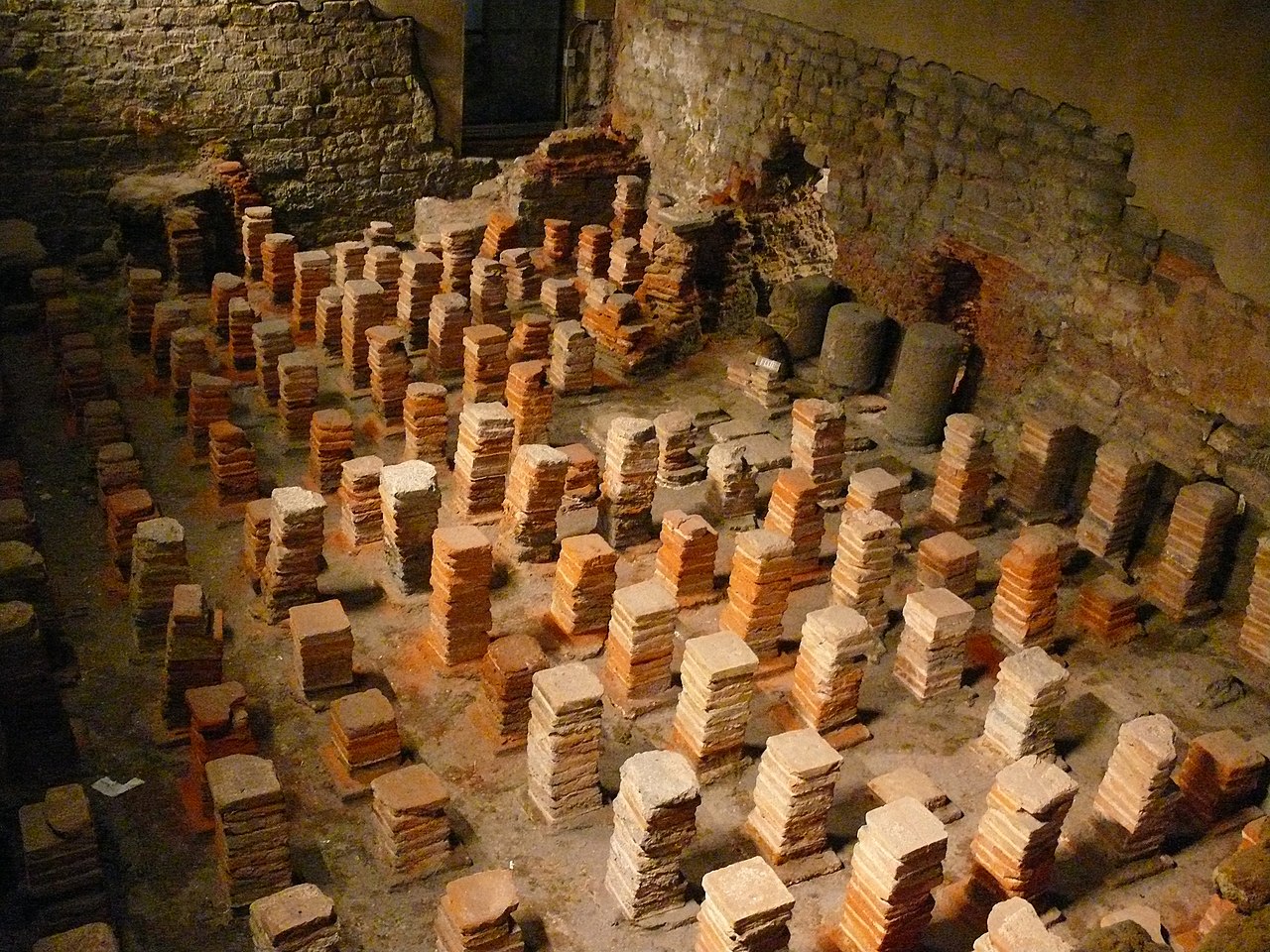
The hypocaust in Part 2 could warm floors, walls, rooms, and pools, but the furnace could not feed itself. A working bath required a dependable stream of fuel: wood cut or gathered somewhere, hauled to the building, kept usable, carried to the furnace, burned, and replaced.

Charcoal from Roman bath furnaces gives us pieces of that supply chain. At Groundwell Ridge in Britain, the fuel was mostly oak, with some poplar or willow. At the later Roman villa of Faragola in southeastern Italy, researchers found wood from oak-growing areas, riverside species such as poplar and willow, and likely orchard prunings from olive and pomegranate trees.

These are individual sites, not a fuel list for the whole empire. Their differences are the point. Bath operators used what local landscapes and local economies could provide. A large heated complex tied comfort inside the building to woodland, farms, carts, storage space, roads, and repeated deliveries outside it.

It is tempting to turn that into a simple story in which Roman baths stripped entire regions of forest. The evidence is not that tidy. Romans also managed woods, coppiced trees, burned agricultural waste, and drew fuel from changing sources. Consumption could be substantial without being identical everywhere.

The honest conclusion is smaller and harder to escape. Every hour of Roman heat had to be grown, collected, or cut before it could be burned.

The Fire Left a Mess

The polished side of a bathhouse gave visitors warm rooms and hot water. The service side received the smoke, ash, soot, and heat that produced them.

We know much less about individual furnace workers than we do about Frontinus. Inscriptions preserve bath attendants, managers, oil workers, and other occupations, but they rarely give us a clean description of one person’s shift at the fire. Neo, the enslaved bath manager from Part 1, proves that a person could be reduced to a job title after death. His inscription does not tell us that he tended a furnace, and we should not assign him work the evidence does not.

The physical demands remain visible without inventing a biography. Furnaces accumulated ash and charcoal. Fuel had to be moved close enough to use. Fires had to be started, fed, and adjusted as bathers, weather, and operating hours changed. Damaged floors and flues needed repair. None of that happened in the marble rooms visitors came to enjoy.

Ancient comfort moved discomfort somewhere else: toward the furnace room, the woodpile, the road, the quarry, the aqueduct channel, and the lungs nearest the smoke.

Who Paid for Public Comfort?

Calling a Roman bath or fountain “public” answers who could use it more readily than it answers who carried its cost.

Frontinus’s records show several payers. The state treasury supported one aqueduct crew, helped by income from water rights near public works. The emperor’s purse paid the other crew and covered lead, conduits, reservoirs, and basins. Bathhouses could be supported by owners, admission charges, wealthy patrons, or imperial spending, depending on the place and period.

Then there were costs that did not appear neatly in an account: enslaved labor, dangerous heat, smoke, damaged bodies, cut fuel, and water redirected by people with enough influence to take it.

Public baths genuinely widened access to hot and cold water. Rome created places where people who could never own a seaside villa like the wealthy senator Pliny’s could still wash, exercise, meet friends, and move through rooms built for different temperatures. That achievement should not be dismissed; it should be seen whole.

Roman comfort depended on who controlled the property, as Part 3 argued. It also depended on who controlled the water, fuel, money, and labor beyond the room. The technology inside the wall was only the visible end of a much larger system.

What Rome Actually Built

Rome’s heating and cooling methods were uneven. A wealthy household could combine good orientation, shade, movable windows, private water, seasonal rooms, servants, and hypocaust heat. A tenant might have a brazier, blankets, shutters, a public fountain, and temporary relief at a bath or portico. Climate, building type, and local materials changed the answer across the empire.

The Romans did not create one universal comfort system. They assembled many partial ones—and, at their best, built organizations capable of keeping them alive.

That may be the most useful lesson in the entire series. The hypocaust was clever, but it failed when masonry cracked or the fire stopped. A shaded court helped only while the building and its openings were managed. An aqueduct was magnificent, but its water still depended on inspections, honest records, clear channels, sound mortar, emergency planning, and hundreds of workers.

A Roman bath could look permanent: marble underfoot, vaults overhead, water arriving as if by nature. Frontinus knew better. Tomorrow the channel would begin collecting another film of mineral, the furnace would ask for more wood, and someone would have to start again.


This concludes the Roman chapter of A History of Comfort. The next chapter will step outside Rome and farther back in time, following how another culture learned to live with heat, cold, water, wind, and the limits of the buildings people could afford.

Research notes and sources

Monday, September 21, 2026

How Romans Kept Cool Without Air Conditioning — A History of Comfort: Rome, Part 3

Horace knew how to survive a Roman summer: he left Rome.

That escape had not always been available to him. Horace was the son of a freedman. He served as a military tribune under Brutus, ended up on the losing side at Philippi, received a pardon, and bought himself a job as a treasury clerk. Then his poems carried him into the company of Maecenas and Augustus, two of the most powerful men in Rome.

By the time Horace wrote about summer heat, he had something most Romans did not: a country place in the Sabine hills.

He described it without pretending it was a palace. What he wanted was a modest piece of land, a garden, a reliable spring near the house, and woods above it. In another poem, he invited Maecenas to leave the smoke and wealth of Rome and shelter from the dog days in the secluded valley.

The valley’s advantages were simple: elevation, shade, water, and distance from a crowded city.

Horace’s most effective cooling system was the freedom to move somewhere cooler.

An imaginary portrait of the Roman poet Horace

A much later imaginary portrait of Horace by Anton von Werner—not a surviving likeness from Horace’s lifetime. Wikimedia Commons, public domain.

The Sun Was a Design Load

Romans could not lower the outdoor temperature, but their better builders understood that they did not have to invite all of it indoors.

Vitruvius told architects to adapt buildings to climate. In hot regions, he recommended opening them toward the north and east. Within a Roman house, he placed winter dining rooms toward the setting sun, bedrooms and libraries toward the east, and summer dining rooms toward the north, away from the sun’s high summer path.

For spring and autumn dining rooms, he suggested an eastern exposure and keeping the windows closed until the sun had passed midday. The advice is almost two thousand years older than the phrase solar heat gain, but the load was the same.

This was not a machine. It was a collection of decisions made before anyone laid the first brick: which direction a room faced, when sunlight entered it, how many exterior surfaces it had, and whether another wall, roof, tree, or portico shaded it.

The easiest heat to remove is the heat that never enters.

Shade Did Most of the Work

In a large Roman house, an atrium opened part of the roof to the sky and directed rain into a basin called an impluvium. Farther inside, a peristyle might surround a garden with a roofed colonnade. The open center admitted light and air. The portico provided something more useful during a hot afternoon: shade.

We should not turn every Roman courtyard into a passive-cooling machine. An open court exposed to hard sun could become hot. A basin or fountain could produce some evaporative cooling nearby, especially when the air was dry, but it did not refrigerate the surrounding rooms. The result depended on geometry, shade, masonry, openings, wind, and the temperature after sunset.

Used well, those pieces worked together. Roofs and colonnades kept direct sun off walls and people. Masonry absorbed heat slowly, delaying the indoor temperature rise. Cooler night air could carry some stored heat away before the next day began.

A modern simulation of one Pompeian house suggested that occupants of that particular design could have been reasonably comfortable in summer, although they would have needed added heat in winter. A computer model cannot tell us exactly how an ancient person felt, but it supports the basic physics visible in the ruins: shade and mass could flatten the daily swing.

The atrium and impluvium of the House of the Vettii at Pompeii

The atrium and rainwater basin of the House of the Vettii at Pompeii. Open courts brought light and air into the house, but their thermal performance depended on shade and the surrounding construction. Photo by Mary Harrsch/Wikimedia Commons, CC BY-SA 4.0.

Air Still Needed a Path

“Natural ventilation” can sound like a feature that comes free with a window. It does not. Air needs an opening to enter, another route to leave, and enough wind or temperature difference to move it.

Pliny the Younger’s seaside villa shows how deliberately a wealthy Roman could manage those paths. His long covered portico had windows on both sides. In fair weather they could all be opened. In strong wind, the openings on the exposed side were closed and those on the sheltered side were used instead. During summer, he wrote, the portico caught westerly winds and circulated them through the building.

Its shade moved with the sun, protecting one side in the morning and the other in the afternoon. The same structure blocked unpleasant winter winds and accepted summer air when it was useful. The building did not maintain one set condition. Its occupants operated it.

Doors, shutters, curtains, and windows were the controls. Rooms were the zones. People opened, closed, and moved between them as the sun and wind changed.

That required choices. It also required somewhere else to go.

Water Cooled People Better Than Houses

Water appears everywhere in stories about Roman cooling, sometimes with more power than the evidence gives it.

A pool, fountain, or wet surface could cool the air immediately around it through evaporation. Water was even more dependable when applied directly to the person: drinking it, washing, swimming, or stepping into the cold room and cold pool of a bathhouse. The Romans did not need to lower the temperature of an entire building to lower the temperature of a body.

For the wealthy, water could become theater. Private houses and villas had fountains, garden basins, swimming pools, and cold baths. The richest could go further. In Epigram 14.118, Martial warns a slave not to mix snow-chilled water with cheap Massilian wine because the water might cost more than the wine. Seneca complained about people mixing snow with wine or chipping ice into their drinks.

Somebody had carried that snow down from the mountains and preserved enough of it to survive the trip and the season. Every cold mouthful in August represented a long chain of mountain labor, storage, transport, and loss—and a customer rich enough to pay for what melted along the way.

Ordinary Romans had access to water, but usually not in the same way. Around the end of the first century, Rome’s water commissioner Frontinus recorded 591 public basins supplied by the aqueduct system, along with ornamental fountains, baths, and other public uses. At Pompeii, street fountains served most of the population because relatively few private houses were connected directly to the mains.

The public fountain was valuable. It was not indoor plumbing. Water carried upstairs in a jar could cool and clean the people in a room, but it could not turn the apartment into Pliny’s villa.

The Apartment Had Fewer Answers

This is where the evidence becomes less personal. Wealthy Romans wrote letters about their villas. Architects wrote instructions for patrons who could afford architects. People renting one or two rooms high in an apartment building did not leave us summer comfort reports.

The building physics still tells us something. A small room beneath a sun-struck roof, with limited openings and little opportunity for cross-ventilation, could hold heat long after the street began to cool. Cooking, lamps, bodies, and work added more. Opening a shutter might release heat, admit a breeze, admit afternoon sun, or do all three at different hours.

A tenant could use shade, water, light clothing, a hand fan, or a cooler public place. Porticoes shaded parts of the city. Public baths offered water and cold rooms. In the Colosseum, a vast fabric awning shaded spectators.

Those were real forms of relief. They were also temporary. At the end of the day, the tenant climbed back to the same room.

The rich did not possess secret laws of thermodynamics. They possessed more ways to take advantage of them: northern rooms, shaded gardens, private water, controllable windows, country estates, coastal villas, servants to move furniture and operate shutters, and enough spare space to abandon a room when it became uncomfortable.

Roman cooling was not divided between people who knew the tricks and people who did not. It was divided by who controlled the building.

Horace’s Country Air

Horace liked to present his Sabine life as modest. Compared with an emperor’s palace, perhaps it was. Compared with a rented upper room in Rome, a spring, a garden, woods, and a second place to live were an enormous environmental advantage.

His poems make that advantage feel human. He wanted relief from obligations, noise, ambition, smoke, and heat. He wanted a patch of shade where he could eat, drink, think, and write. The Roman answer to summer was never only architectural because discomfort was never only a temperature reading.

The best Roman houses could soften the heat. They could delay it, shade it, vent it, and give their owners another room when it arrived. Public water and public buildings gave many other Romans moments of relief.

When Horace sat beside his spring, the valley supplied the pieces Roman cooling needed: shade, water, moving air, and somewhere for the day’s heat to go. Back in Rome, relief was often measured in hours—where a wall cast shade, which fountain was nearest, and how long a roof would hold the day’s heat.


Next in A History of Comfort: Roman comfort consumed more than clever ideas. Part 4 will follow the wood, water, smoke, maintenance, and human labor that kept the system working—and ask who paid the real cost.

Research notes and sources

Wednesday, September 16, 2026

How Ball Arena Keeps Colorado Avalanche Ice Cold

The refrigeration system beneath the rink is only half the job. Above it, roughly 18,000 people, open doors, concert lights, and a 675,000-square-foot building are all trying to change the temperature.

Exterior of Ball Arena in Denver, home of the Colorado Avalanche

Ball Arena in Denver. Photo by Troutfarm27, licensed CC BY-SA 4.0.

The first major event at Ball Arena was not a hockey game.

It was a Celine Dion concert on October 1, 1999.

That feels appropriate for a building that has spent its life changing identities. One night, it is an NHL rink. On another it is an NBA court. Then somebody builds a concert stage over the ice, fills the bowl with lights and haze, and asks the building engineers to make the air behave differently than it did the night before.

The Colorado Avalanche make Ball Arena look like a hockey building. The ice crew makes it look inevitable. Neither impression is quite true.

Ice inside an arena is a temporary victory over heat. It sits beneath thousands of bodies, television lights, and a roof covering more than 675,000 square feet. Every open loading-dock door brings in outdoor air. Every concert adds equipment, people, and a new list of temperature requests. Even when the ice is hidden beneath a basketball floor, it is still down there exchanging heat with the building.

Keeping it playable requires two mechanical worlds to work together. One is beneath the slab: chillers, pumps, glycol and controls. The other is above it: air handlers, outside air, exhaust, humidity, and pressure.

The interesting part is what happens where those worlds meet.

Before the puck drops

Colorado Avalanche hockey game inside Ball Arena

An Avalanche game inside Ball Arena. Photo by Murphpics, licensed CC BY-SA 4.0.

Danny Nichols is Kroenke Sports & Entertainment's Executive Director of Engineering and Sustainability. His responsibilities extend beyond Ball Arena to other KSE properties. Still, in an interview with the Rocky Mountain Mechanical Contractors Association, he described what his crew does before an Avalanche crowd arrives.

They start pulling the arena bowl down to about 55 or 56 degrees.

Once the doors open, the crowd does the rest in the wrong direction. Thousands of warm bodies enter. Concessions run. Lights come on. The bowl temperature rises quickly toward 60 degrees. Nichols said the crew tries to keep it below roughly 64 degrees during hockey because warmer conditions can soften the ice.

In January, Denver may give the engineers some free cooling. Outside air can help carry the load.

The playoffs are another matter. Nichols described late-season games with outdoor temperatures near 100 degrees, while the bowl remained around 60 degrees. That is a serious temperature difference across a building whose doors keep opening.

Two built-up air handlers serve the arena bowl. Nichols put each at about 175,000 cubic feet per minute. About fifteen more air handlers serve the concourses, offices, and other spaces.

Those numbers are big, but the problem is familiar to anyone who has worked on a small commercial system. The occupied space changes faster than the equipment can. By the time a sensor notices the crowd, the crowd is already there.

The ice beneath the concrete

The rink begins below the surface people see.

Refrigerated glycol moves through piping beneath the concrete slab. A Denver Water profile of longtime ice manager Tony Kreusch described the slab as being held around 14 degrees. Water is then frozen in thin layers rather than dumped into place all at once.

The crew first creates a base. A white layer gives the rink its clean appearance. Lines and logos are applied, then sealed under more water. The finished sheet is typically about 1¼ inches thick.

That is not much room for error. Too thick, and the refrigeration plant has to work through unnecessary ice. Too thin, and skates can reach paint or concrete.

The water matters too. Ball Arena has used reverse-osmosis water because dissolved minerals and trapped air can affect clarity and hardness. In a 2014 interview, Kreusch said a typical game day could include as many as ten resurfacing cycles and use about 3,000 gallons of water. The resurfacing water was heated to roughly 140-160 degrees so it would flow into the skate cuts before freezing.

Hot water on ice sounds backward until you think about the job. The goal is not merely to freeze water. It is to leave behind a thin, smooth repair.

Kreusch also made a point in a later Zamboni interview that applies far beyond rinks: ice is forgiving, but you need time.

Mechanical systems are forgiving in much the same way. If you notice the problem early enough, you can usually make an adjustment. If the building is already full, the schedule is added to the load.

When the rink disappears

Ball Arena does not remove the ice for every basketball game or concert. Crews cover it with roughly 600 one-inch fiberglass panels.

Nichols described the panels as approximately four feet by eight feet. A normal changeover takes about four hours. When the schedule gets ugly, the crew has completed one in roughly two to two and a half hours.

Once the floor is covered, the refrigeration cycle changes. Nichols said the ice plant can start at a slab temperature near 19.1 degrees and pull it down to about 16 degrees in roughly an hour. Then the plant may remain off for around four hours while the panels insulate the surface. With the ice exposed, it gains heat faster, and the plant may cycle again in about two hours.

The covered rink is not out of mind. Kreusch said spills at concerts can work through joints in the panels and reach the ice. By the time the floor comes up, the crew may find divots or other damage that has been hidden for days.

That is one of the least glamorous parts of arena work. The show leaves town. The trucks leave the dock. Somebody stays behind to find out what happened underneath it all.

Denver's dry air helps, until it doesn't

Humidity is one of the biggest enemies of arena ice. Moist air can condense near the surface, create fog and add frost. Denver's climate gives Ball Arena an advantage compared with buildings in wetter cities.

Kreusch has said the region's low humidity, water quality and steady winter conditions are all helpful.

Dryness creates a different problem when the ice is covered. Water can slowly leave the sheet. The ice can shrink, pull away, or develop weak spots while nobody can see it. A climate that makes the building easier to dehumidify can make the rink harder to preserve under a temporary floor.

There is no single perfect humidity number that solves an arena. The right condition depends on the event, the outside air, and whether the ice is exposed.

When a concert wants less air

Concert lighting and haze inside Ball Arena

Depeche Mode at Ball Arena in November 2023. Photo by MerleEllaPatsy, dedicated to the public domain under CC0 1.0.

A hockey game wants cold air moving through the bowl. A concert may ask for almost the opposite.

Touring productions use haze, so beams of light become visible. Too much supply air can push that haze away from the stage and into the concourses. Air movement can also interfere with pyrotechnics. Nobody wants a flame effect leaning toward the audience because a diffuser is doing its job.

Nichols described a balancing act. His crew can pressurize the concourses, slow the bowl fans, and adjust the exhaust so the haze stays where the production wants it. What they cannot do is simply shut off ventilation in a packed arena.

Some touring crews still ask for no moving air over the stage. That request makes sense from their side of the curtain. It does not make 18,000 people stop breathing.

What I take from that is simple: air does not care what the concert rider requested. It follows pressure.

The building has to satisfy both the show and the people inside it. Most spectators never know that negotiation is happening.

Two kinds of chillers

Ball Arena's comfort-cooling plant and ice plant do different work. Both use compressors, condensers, evaporators, and controls, but they do not live the same life.

The air-conditioning chillers respond to people, outdoor temperature, and changing building loads. The ice chillers hold a slab cold for long periods and must recover it on an event schedule.

Before the 2019–20 NHL season, one Trane ice chiller was converted from R-134a refrigerant to R-513A, sold by Chemours as Opteon XP10. According to a Chemours case study, the conversion involved changing the refrigerant, compressor lubricant, and controls rather than replacing the entire chiller.

Ball Arena's redundant chiller arrangement created an unusual comparison. A third party logged two similar machines under operating conditions. The converted machine averaged a measured load of 102 tons. The R-134a machine averaged 104 tons. Both averaged 0.91 kilowatts per ton.

In other words, the published test found similar efficiency and capacity. The main reported gain was refrigerant impact. The case study listed a global-warming potential of 631 for R-513A and 1,430 for R-134a, a reduction of about 56 percent.

Those numbers deserve a boundary around them. Chemours sponsored the case study, even though a third party gathered the energy measurements. The figures describe the measured machines during the test, not every possible operating condition. The document also does not establish the present refrigerant status of every chiller at the arena.

Still, the project shows what retrofit work usually looks like. The old equipment does not vanish because a cleaner option exists. Someone has to make the new refrigerant work with the compressors, lubricant, controls, piping, and schedule already in the building.

Retrofits are rarely as clean as the diagrams drawn for them.

There is always an existing pipe in the way.

Heating and cooling at the same time

The most surprising thing Nichols described was not how cold Ball Arena gets. It was how much heating can happen at the same time.

During certain events, the ice plant can run hard while the building's boiler plant sends out water as hot as 180 degrees. Nichols described days with temperatures around 45 to 50 degrees outside when the chillers were operating at full load, and the boiler plant was also operating.

That is not necessarily a control failure. The rink still needs refrigeration. The concourses, offices, and perimeter spaces may need heat. Outside air still has to be conditioned. One large building can have a winter and a summer happening in it at once.

Nichols discussed the possibility of capturing heat now rejected from the ice plant and using it on the heating side. It was an idea being explored, not a system he said was already operating.

The opportunity is easy to see. A refrigeration plant does not destroy heat. It moves it. If the building is paying to reject heat at one plant while paying to make heat at another, recovery may be worth studying.

The hard part is getting the temperatures, loads, piping, and timing to line up. Useful heat is not always useful when it becomes available.

What the utility numbers can and cannot tell us

Denver's building performance records provide a whole-property view of Ball Arena. For 2024, the reported property used about 12 million kilowatt-hours of electricity and 27,935 million Btu of natural gas. Total site energy was about 68.8 billion Btu, with a site energy-use intensity of 97.5 kBtu per square foot.

The same record lists a baseline EUI of 90.5 and a 2030 target of 63.4.

Those figures are useful, but only at the scale they were reported. They cover the property, not just the ice plant or HVAC equipment. They cannot tell us how much energy went to refrigeration, kitchens, lighting, concerts, offices, or a deep playoff run. The reporting area also differs from the arena's public description, another reason not to force the numbers into a precision they lack.

An arena's calendar matters. A year with more events can use more energy even if a plant operates better. A warm playoff season is not the same as an empty January. Whole-building data can show direction over time. It cannot explain the whole building by itself.

The people between the systems

Nichols did not begin his career with a polished sustainability title.

In the RMMCA interview, he described working for a millwork company before a burst pipe and flood changed his direction. He became a utility engineer, moved into HVAC as an apprentice, and taught himself the refrigeration cycle. He learned an older Tracer Summit control system by following the sequence through VAV boxes, air handlers, pumps, and chiller proof-of-flow.

That is a familiar route into the trade. First you learn which piece failed. Then you learn what had to happen before that piece could run. Eventually, the building starts to look less like a pile of equipment and more like a conversation.

During events, Nichols said the engineering staff includes an HVAC engineer, a carpenter, and an audiovisual technician. Their best nights may be the ones the crowd never notices.

He gave a fine example. During a live Nuggets game, a valve failed while a boiler pump was being replaced. Roughly 5,000 gallons of water and glycol spilled backstage. The game continued. The spectators had no idea.

That may be the clearest explanation of arena maintenance I found.

People watch the puck, the ball, or the stage. Behind the doors, somebody is isolating a line, moving water, checking temperatures, and trying to keep one bad valve from becoming everybody's problem.

The cold part is only half the story.

I started looking into Ball Arena because I am an Avalanche fan and I work in HVAC. I expected the ice plant to be the star.

It matters, of course. The glycol has to move. The compressors have to run. The slab has to stay cold.

But the ice is also protected by air handlers high above the seats, by an operator watching humidity, by a crew laying hundreds of floor panels, and by engineers making changes before a crowd walks through the doors. It survives basketball games, concerts, open docks, and Denver weather because so many people keep giving it attention.

The next time the Avalanche skate out, the ice will look simple. That is probably the compliment the crew wants.

It means the complicated part stayed out of sight.


Research notes and sources

The RMMCA interview and Zamboni video were reviewed directly. Technical details attributed to Nichols and Kreusch were transcribed from the recordings and paraphrased here. No site visit or original interview was conducted for this article.

Monday, September 14, 2026

How Roman Hypocaust Heating Worked—and What Happened When It Failed — A History of Comfort: Rome, Part 2

Vitruvius knew he wasn’t much to look at, and he was willing to tell the emperor so.

He was getting older. His health was failing. Nature, he wrote, had not given him an impressive build, and age had done his face no favors. He told Augustus about Dinocrates, an architect who won Alexander the Great’s attention by appearing dressed as Hercules, complete with a lion skin and club. Dinocrates proposed carving Mount Athos into a colossal figure of Alexander, with a city in one hand and a basin catching the mountain’s water in the other.

Vitruvius had no lion skin, no club, and no mountain-sized sales pitch. He would have to make do with knowledge.

I like him for that. He doesn’t enter this story as a flawless Roman genius carved in marble. He enters as an aging engineer hoping the things he learned on the job would count for something after strength and appearance stopped helping him.

By his own account, Vitruvius had worked with military machinery. Later, sometime during the reign of Augustus, he gathered what he knew into the ten books we call De architectura, or On Architecture. He wrote about temples, water, building materials, machines, acoustics, and quite a few other things an architect was apparently expected to understand.

Then he got to bathhouses, and his writing begins to sound familiar to anyone who has had to make a heating system work in an actual building.

A 1684 illustration imagining Vitruvius presenting his book to Augustus

Vitruvius, at right, presenting his work to Augustus in a much later artist’s imagination. This is not a contemporary portrait. Illustration by Sébastien Le Clerc/Wikimedia Commons, public domain.

The First Control Was the Building

Vitruvius did not begin his instructions with the furnace. He began with the sun and wind.

Choose the warmest possible location, he advised, sheltered from the north and northeast. Put the hot and warm rooms where they could receive afternoon sun, because Romans generally bathed from midday into the evening. Place the men’s and women’s heated rooms next to one another so one furnace and one group of water vessels could serve both.

The principle behind all three instructions was simple: before burning more wood, reduce the load.

It also complicates the usual picture of Roman heating. The hypocaust was not a magic appliance dropped beneath any room. Its performance depended on orientation, room arrangement, masonry, distance from the fire, and the path available to the combustion gases.

A bad layout would remain a bad layout. The person tending the fire could only fight it with more fuel.

A Floor Built Over Empty Space

The fire burned in a praefurnium, a furnace opening built beside the rooms being heated. From there, the hot combustion gases entered a low space beneath the floor.

Vitruvius specified a lower floor sloping toward the furnace. His test was wonderfully simple: throw a ball onto it. If the ball rolled back toward the furnace mouth, the slope should help the flame and hot gases spread beneath the room.

Small brick piers called pilae rose from that lower floor. Large tiles bridged the piers, and layers of mortar, concrete, tile, stone, or mosaic formed the finished floor above them. Vitruvius called for piers roughly two Roman feet high, although surviving hypocausts vary considerably.

In more elaborate systems, especially those developed after Vitruvius wrote, hollow terracotta boxes or other flue arrangements carried the hot gases upward behind the wall surface before venting them outside.

The smoke was not supposed to blow into the room like air from a supply register. Fire heated the floor and walls; those heavy surfaces then warmed the room. The resemblance to modern radiant heating is real, but the Romans were moving combustion gases beneath the structure, not circulating hot water through sealed tubing.

Brick pillars and the furnace opening of a Roman hypocaust at Vieux-la-Romaine in France

The brick pillars and furnace opening of a reconstructed Roman hypocaust at the House with the Grand Peristyle in Vieux-la-Romaine, France. Photo: Pascal Radigue/Wikimedia Commons, CC BY-SA 4.0.

One Fire, More Than One Job

In a bathhouse, warm floors were only part of the demand. The bathers also expected hot water.

Vitruvius described three bronze vessels arranged near the furnace: one hot, one tepid, and one cold. As hot water was drawn off, it was replaced from the tepid vessel. The tepid vessel was replenished from the cold one. The same fire could heat the rooms and support a staged hot-water system.

It was clever, but it was not automatic.

At Groundwell Ridge in Roman Britain, researchers studied charcoal recovered from a villa’s hypocaust furnace. The fuel included mostly oak, with some poplar or willow, and the evidence suggested furnace temperatures around 330–410°C, or 626–770°F.

That fire had to be started early enough to warm a thick masonry floor. It had to be fed as people arrived and as water was used. Ash had to be removed. The person working there had to judge the wood, the draft, the weather, and the slow response of the building.

In Part 1, we met Neo, an enslaved balneator whose work was connected to a bath. We cannot prove that Neo tended a furnace, and I’m not going to assign him a job his inscription does not give him. What his story does remind us is that Roman comfort depended on people whose work was rarely described by the people enjoying it.

The hypocaust had no blower, temperature sensor, control board, or high-limit switch. The worker beside the furnace was most of the control system.

How Romans Adjusted the Heat

They did have ways to influence it. The obvious control was the fire: how much fuel went in, how quickly it burned, and how long it had been burning. Room placement created another kind of control. The hottest spaces could sit closest to the furnace, with warm rooms farther along the heat path.

Vitruvius also described an opening in the domed ceiling of a sweating room. A bronze disk hung beneath it on chains. Raising or lowering the disk changed the opening and regulated the temperature.

Pliny the Younger described a smaller system in his villa that used a narrow trapdoor to release or retain hot air. Neither device was a thermostat. Both gave somebody a way to respond.

The problem was response time. Thermal mass is patient. People usually aren’t. A heavy Roman floor took time to heat and kept releasing heat after the fire changed. An operator could add fuel quickly, but the room would not answer quickly. If he waited until bathers complained that it was cold, he was already behind.

When the System Failed

No Roman furnace manuals or completed service tickets have come down to us. We have Vitruvius telling builders how to avoid trouble, and we have damaged buildings showing where trouble found them anyway.

At a late Roman bath excavated in Corinth, repeated firing wore away the inside of a furnace that had originally been built as a narrow space between two walls. Continued use rounded and eroded the opening. At least once, someone lined the damaged interior with cement and put it back to work—a repair any tradesperson would recognize: remove what has failed, rebuild the surface, and keep the equipment running.

Elsewhere, repair was not worth it. At a Roman villa site near Conisbrough in Britain, excavators concluded that heat had degraded sandstone used for some of the hypocaust pillars. Parts of the system were deliberately dismantled, and the empty underfloor space was filled to bring it back to the old floor level.

They abandoned the heat but kept the room.

Between those outcomes were plenty of possible problems. Furnace masonry faced direct flame and repeated heating. Piers carried a thick floor while cycling hot and cool. A poor draft or restricted gas path would reduce heat. Cracks in the suspended floor could allow smoke and combustion gases to go where they did not belong.

We should be careful here. Archaeology can show ash, erosion, patched masonry, altered flues, replacement floors, and abandoned systems. It usually cannot tell us what an operator noticed on a particular morning or exactly how often occupants breathed bad air.

The evidence does tell us that these systems were repaired, rebuilt, modified, and sometimes given up on. Roman engineering was durable. It was not maintenance-free.

Vitruvius’s Real Lesson

Vitruvius is often reduced to the man behind Leonardo da Vinci’s drawing of the ideally proportioned human body. That is a little unfair to an engineer who openly admitted that his own body was aging badly.

His bathhouse instructions are valuable because they are not really about one brilliant invention. They are about making the entire building cooperate: use the sun, block the wind, group the loads, slope the path, support the floor, control the opening, and leave somebody responsible for the fire.

The hypocaust was the visible achievement only after its floor was torn open. To a Roman bather, the best version of the system disappeared beneath warm stone.

Vitruvius hoped his knowledge would succeed where his appearance and strength could not. On that point, he was right.

His instructions survived.

The name of the person who kept the fire burning usually did not.


Next in A History of Comfort: Rome had warm floors, but summer still came. Part 3 will look at how Romans used shade, courtyards, windows, water, and the movement of air to keep cool—and who had enough space to make those ideas work.

Research notes and sources

Monday, September 7, 2026

AI Isn’t Taking My Tool Bag. But It Is Changing the Job

Labor Day evening, I worked through a list I had made the night before.

I told myself I would stop at noon. I nearly did.

Later, I checked the X account I had been trying to bring back to life. I had posted several times, replied to others, and tried to write something worth reading.

Not much happened.

A few people saw the posts. Nobody new followed.

That is not exactly a hardship. It doesn’t compare to working outside in bad weather, getting called out on a weekend, or trying to bring a neglected system back from the dead.

Still, it got me thinking about two kinds of systems I am learning to work around: the new technology changing the trade and the online machinery changing how people find the work—and the people who understand it.

In the physical world, I can usually follow the path between effort and result. A contactor closes. A motor starts. A blower moves air. If the air never reaches the room, there is a reason. Maybe the duct is undersized. Maybe a damper is closed. Maybe somebody buried a filter behind twelve years of dust.

Online, the path is harder to see.

You can write something decent, push the button, and watch it disappear.

Another invisible system

X says its recommendations depend on signals such as the accounts and topics people follow, the posts they like, what their networks like, and whom those networks follow. In other words, publishing something does not mean it will be distributed. The platform decides where it might fit and whether anyone is likely to care.

That sounds a little like ductwork.

Creating the post is only the beginning. It still has to travel through a system, pass several restrictions, and arrive in front of somebody who wants what it carries. If it never reaches the room, it doesn’t matter how good the air was when it left the unit.

The difference is that I can open a panel, follow a duct run, and usually find the restriction. I cannot open the algorithm and see where the post went.

That isn’t a complaint. It is a reminder that there are important systems around us that most people never see.

I happen to work on some of them.

Now I am trying to understand the others.

The trade is not disappearing.

There is plenty of talk about artificial intelligence and robots replacing people. Some of it is serious. Some of it sounds like it was written by someone who has never opened a mechanical room door.

The numbers do not show HVAC work disappearing.

The Bureau of Labor Statistics projects employment for HVAC and refrigeration mechanics and installers to grow 11 percent between 2025 and 2035, compared with 3 percent for all occupations. It expects roughly 40,600 openings each year over that period.

BLS points to sophisticated climate-control systems and commercial construction, including data centers, as demand drivers. In practice, that means technicians will encounter more computerized, connected equipment—and will need to understand more than the mechanical side of the system.

That last part deserves a minute.

Artificial intelligence is often described as if it lives somewhere above us in a clean, weightless “cloud.” It doesn’t. It runs on physical equipment inside real buildings. Those computers consume electricity and produce heat. The facilities need cooling equipment, pumps, fans, controls, piping, maintenance, and people who understand how it all works.

Even the cloud needs supply and return.

AI may change parts of the trade. At the same time, the infrastructure supporting AI is creating more mechanical work.

Both things can be true.

The equipment is learning to watch itself

The change is already happening inside buildings.

The Department of Energy has been working on automated fault detection and diagnostics for HVAC systems. These tools use operational data to identify faults and, in some cases, narrow down their causes. DOE has also supported work that goes beyond finding problems toward automatically correcting certain control, scheduling, sensing, and operating faults.

NIST now has an AI-Optimized Building Controls project developing and testing AI-based control algorithms for HVAC operation.

This is not a robot walking into a basement with a recovery machine. It is software watching temperatures, pressures, commands, setpoints, and equipment behavior all day long.

That could eliminate some diagnostic work. It could also expose problems that have gone unnoticed for years.

A building may eventually recognize that a valve is leaking, a sensor is drifting, or a control sequence is wasting energy before anyone complains about comfort. The service call could arrive with a stack of trend data instead of the usual description:

It just doesn’t seem right in here.

That does not make the technician useless. It changes where the technician enters the problem.

Software may identify an abnormal pattern. Somebody still has to decide whether the sensor is wrong, the programming is wrong, the actuator is stuck, the wiring is damaged, or the mechanical system simply cannot do what the screen is asking it to do.

A clean graphic cannot loosen a rusted fastener. An alarm cannot tell you everything the installer did behind the wall, and a diagnostic model only knows what its sensors can see. Field experience may matter even more when a computer is confidently pointing everyone in the wrong direction.

Robots like repetition. Service work rarely cooperates.

Robotics will probably reach the controlled parts of trade work before it handles the messy ones.

A machine can cut the same shape repeatedly. It can load material, move parts, or make the same motion all afternoon without getting tired. NIST has described collaborative robots as tools that can remove monotonous work such as picking, placing, packaging, and loading machinery while allowing skilled workers to concentrate on more valuable tasks.

That makes sense in a shop.

A service call is different.

The equipment may be thirty years old. The access panel is blocked. The previous repair left three wire nuts, two abandoned wires, and no diagram. The homeowner remembers a noise that the unit has refused to make since the truck pulled into the driveway.

The real world is full of variation.

That does not mean robotics will never handle it. It means the difficult part is not merely turning a wrench. It is recognizing what kind of problem is actually in front of you.

The International Labor Organization studied occupational exposure to generative AI and estimated that about one in four jobs worldwide has some degree of exposure. Its conclusion was not that one in four jobs would disappear. The researchers said transformation is more likely than replacement because most occupations still include tasks that require human involvement.

That feels closer to what I see.

Jobs are bundles of different tasks. Technology rarely takes the whole bundle at once. It starts with the portions that are repetitive, measurable, or easy to perform from a screen.

Being useful is no longer the whole job.

But the technology inside the work was only half of what bothered me that Labor Day afternoon.

In the trades, it is tempting to believe that good work speaks for itself. Sometimes it does. A system runs. A customer is comfortable. A building owner stops calling.

But businesses are discovered online now. Customers form opinions before anyone arrives at the house. Young people learn what a career looks like from the people willing to show it to them. Manufacturers collect equipment data. Software schedules calls, prices work, and decides which advertisements appear on which phones.

Meanwhile, an algorithm helps decide whose knowledge gets noticed and whose disappears into the feed.

Knowing the physical work remains valuable. Pretending that the digital systems around it do not matter would be naive.

I don’t need to turn into a technology expert or spend every evening trying to impress an algorithm. I do need to understand enough to recognize where the work is going.

That means learning what the equipment can measure.

It means understanding what automated diagnostics can—and cannot—tell me.

It means paying attention to robotics, controls, and the businesses that build them.

It also means learning how ideas travel online, even when doing so feels less honest than tracing a wire or putting a meter on something.

One more system to learn

Every trade has changed with its tools.

Technicians learned electronic ignition, variable-speed motors, inverter-driven equipment, digital controls, and networked systems. None of those developments made mechanical judgment worthless. They gave experienced people more things to understand—and occasionally more things to blame.

AI and robotics are the next part of that story.

I’m not worried that a robot will arrive tomorrow morning and ask for my tool bag. I am more interested in the technician standing beside me who understands the equipment, the controls, the data, and the customer better than I do.

That person will have an advantage.

So I’ll keep learning the physical systems. I’ll also keep trying to understand the invisible ones deciding how buildings operate, how businesses are found, and which ideas reach another person.

A quiet X account is a small place to start.

But every unfamiliar system looks a little less mysterious once you begin tracing where everything goes.


Research notes and sources

How Romans Heated Their Homes—and Who Got Left in the Cold — A History of Comfort: Rome, Part 1

Ancarenus had to die to find a place where he could live rent-free.

His full name was Ancarenus Nothus. He was a formerly enslaved man who lived in ancient Rome and died at 43. We don’t know what he did for work or exactly where he lived. Most of what remains of him is a short inscription placed with his ashes in a shared tomb outside the city.

It says that his bones can rest now. He no longer has to worry about hunger, aching legs, or coming up with money for rent. His lodging is free forever.

It is a dark little joke, but it tells us more about ordinary Roman life than another marble statue of an emperor ever could. Rent followed this man all the way to his grave.

I read a lot, and I have a habit of following a question farther than I meant to. Lately, I started wondering how people dealt with heat and cold before there was electricity, modern equipment, or anyone to call when something quit.

Rome seemed like a good place to start. The Romans were serious builders, and some of what they built looks surprisingly familiar to anyone who works in HVAC. But they weren’t the first people to solve these problems, and the story didn’t end when their empire did. Every part of the world has its own history of keeping people warm, cool, and alive.

Every once in a while, I’m going to follow another piece of that story—one place and one system at a time. This will still be an HVAC blog. Just not always the kind of HVAC that comes with a model and serial number.

Two Romans, Two Ideas of Home

Nothus measured a home by whether he could afford to stay in it.

Pliny the Younger measured one by the direction of the afternoon wind.

Pliny was a wealthy Roman senator and writer. Around the beginning of the second century, he sent a friend a long description of his seaside villa. He explained which rooms caught the morning sun, which were protected from winter winds, and which stayed pleasant in summer because of their height and shade.

He had cold, warm, and sweating rooms, along with a heated swimming pool overlooking the sea. A colonnaded passage leading to one bedroom used built-in channels to catch and circulate hot air. Another small heating apparatus had a trapdoor that could admit or block heat.

Pliny could open windows on the sheltered side of a portico when the wind picked up. He could move to a sunny room in winter and a shaded one in summer. If one part of the house was uncomfortable, he had another part of the house.

That may have been the greatest luxury of all: choice.

Roman comfort wasn’t one invention. It was the whole building. Sun, shade, masonry, wind, water, and room placement were made to work together. Pliny had the money and space to use all of them.

Most Romans Did Not Have Heated Floors

When people talk about Roman heating, they usually jump straight to the hypocaust—the system that moved hot gases beneath raised floors and sometimes through hollow spaces in the walls.

The hypocaust was a real and clever system, common in bathhouses and also found in wealthy homes, villas, forts, and other important buildings—but it was not standard equipment in every Roman apartment.

The empire crossed climates that demanded very different answers, from the dry heat of North Africa to the wet cold of Britain. There was no single Roman home and no single Roman way of heating it.

For many ordinary people, heat came from a hearth, cooking fire, or portable brazier holding charcoal or wood. The warmth stayed close to the fire. So did the smoke and the risks of burns, bad air, and a building fire.

A bronze brazier and pot from Pompeii, now in the Naples National Archaeological Museum

A bronze brazier and pot from Pompeii. Portable fire was a more realistic source of household heat for many Romans than a built-in hypocaust. Photo: Gary Todd/Wikimedia Commons, public domain.

In a rented room, the tenant couldn’t redesign the walls or decide that the bedroom ought to face the winter sun. The building was what it was. Comfort came from clothing, bedding, a small fire if one could be used, and getting through the weather.

We cannot say that Nothus owned a brazier or lived on the top floor of a crowded apartment building. His inscription doesn’t tell us that. What it does tell us is that rent and hunger were real pressures in his life. A man worried about his next housing payment was not living in Pliny’s world of spare bedrooms, private pools, and adjustable heat.

The Heat Below the Floor

The basic idea of a hypocaust was simple enough. A fire burned in a furnace beside the building. Hot combustion gases traveled beneath a heavy raised floor and, in more elaborate systems, through passages in the walls. The warmed floor and walls then radiated heat into the rooms.

The exposed brick pillars of a Roman hypocaust at the Roman Baths in Bath, England

The finished floor rested on these brick pillars, leaving space underneath for hot combustion gases to move through. Photo: Ad Meskens/Wikimedia Commons, CC BY-SA 3.0.

There was no thermostat and no blower. The system depended on fire, natural draft, masonry, and time. A thick floor did not warm instantly. Somebody had to start the fire, feed it, and learn how that particular building behaved.

When I look at the remains of a hypocaust, the little brick pillars are interesting. The part I keep thinking about, though, is the person standing at the furnace.

Someone carried the fuel, cleared the ash, and dealt with a poor draft or a room that would not warm up. The people enjoying the finished space might never see any of it.

That part has not changed as much as we like to think.

What Survives of Neo

One of the people tied to this comfort was named Neo.

His grave marker was found in a burial complex belonging to the Statilii Tauri, a wealthy Roman family. The published reading of the inscription, cataloged as CIL VI 6243, is:

NEO
T. STATILI
TAVRI SER.
BALNEATOR

Expanded, it reads: Neo, Titi Statili Tauri servus, balneator. In English: “Neo, slave of Titus Statilius Taurus, bath attendant.”

A balneator was a bath attendant or manager. Neo may have overseen a private household bath. His owner’s family may instead have operated a commercial one. Historians cannot be certain, and I don’t want to turn him into a furnace tender just because it would make the story neater.

What we can say is that his job was tied to someone else’s comfort.

Pliny used paragraph after paragraph to describe the pleasures of one villa. Neo’s surviving life is essentially his name, his owner, and his occupation.

We do not know whether he liked the work, hated it, or simply did what he had to do. We don’t know whether he became free or even how old he was when he died.

Roman history tells us much more about the person walking across the warm floor than the person responsible for keeping it warm.

Public Comfort, Private Inequality

There was one place where these Roman worlds came closer together: the public bath.

For a very small entrance fee—and sometimes for free—ordinary Romans could enter buildings with warm rooms, hot rooms, cold pools, heated water, and radiant floors. Someone whose rented room had no built-in heat could temporarily use one of the most sophisticated heated buildings in the ancient world.

The bath did not erase class. A wealthy visitor could arrive with enslaved attendants carrying clothing, oils, and personal belongings. A poorer visitor had fewer choices and fewer people looking after him. The same warm room could hold both men, but they had not entered it from the same life.

Below them, the fires still had to be kept burning.

What a Warm Floor Can Tell Us

Roman engineering deserves its reputation. Its builders understood radiant heat, natural draft, solar exposure, and the value of using different rooms in different seasons.

But the system is only half the story.

Nothus left a joke about finally escaping rent. Pliny left detailed instructions for finding the most comfortable room at almost any hour. Neo left his name, the name of the man who owned him, and his job.

Three lives. Three very different relationships with comfort.

Pliny could choose the room.

Nothus had to find the rent.

Neo helped make someone else comfortable.

That is where this history really begins—not with the invention under the floor, but with the people standing above and below it.


Next in A History of Comfort: We’ll go beneath the floor and look closely at how Roman hypocaust heating worked, how it was controlled, what it consumed, and what happened when something went wrong.

Research notes and sources

Sunday, September 6, 2026

Six Things I Wish New HVAC Apprentices Knew

It’s Sunday morning. Coffee is hot, the house is still fairly quiet, and I’ve been thinking about the people getting ready to start their first week in HVAC.

Starting in this trade can make you feel lost in a hurry.

You might understand the basics in class and still have no idea what fitting the lead installer just asked you to grab. You might know how a refrigeration cycle works but spend ten minutes trying to get a furnace door back on correctly.

That’s normal.

The Bureau of Labor Statistics calls HVAC a career with “long-term on-the-job training.” That is the government’s polished way of saying you’re going to spend a while learning things the hard way. The good news is that the trade needs people. HVAC employment is projected to grow 11 percent between 2025 and 2035, which is much faster than average.

If you’re thinking about becoming an HVAC apprentice, here are six things I wish more people knew before their first day.

1. Nobody expects you to know everything

You’re an apprentice. The whole point is that you’re there to learn.

A good technician isn’t going to be shocked because you can’t diagnose a communicating system during your first week. What will frustrate people is pretending you understand something when you don’t.

Ask the question.

“I’m not following that. Can you show me again?”

That sentence will get you farther than nodding your head, guessing, and making the problem worse.

You are allowed to be new. Just don’t be careless about it.

2. Being dependable matters more than looking experienced

Be ready when the workday starts. Keep your phone put away unless it’s needed for the job. Bring water. Wear the right clothes. Help clean up without waiting to be told every single time.

None of that is exciting. It also gets noticed.

A lot of new apprentices worry about proving how much they know. Most experienced workers are watching something simpler: Can we count on you?

Skill takes time. Reliability can start on day one.

3. Carry a notebook and actually use it

You will hear more information than you can possibly remember.

Write down model numbers, wire colors, measurements, tool lists, unfamiliar terms, and questions you want to ask later. If someone shows you how to perform a task, write down the order.

A phone can work, but a small notebook is faster, tougher, and less likely to look like you’re texting while someone is trying to teach you.

Writing things down also tells the person training you that their time matters.

4. Learn the sequence, not just the parts

It’s easy to start memorizing components: pressure switch, contactor, transformer, capacitor, control board.

Knowing the names helps. Knowing what should happen next is what makes you useful.

When a system stops working, ask:

What is the system trying to do, and where did that sequence stop?

That question is the beginning of real troubleshooting. Otherwise, you’re just staring at a box full of parts and hoping the bad one looks burned.

It usually doesn’t.

5. Safety is not something you outgrow

There can be pressure on a new apprentice to prove they aren’t afraid of work. That does not mean putting your hands somewhere you haven’t been trained to put them.

Turn equipment off properly. Verify power. Follow your employer’s lockout/tagout procedures. Wear the protective equipment required for the job. Ask before doing something you have not been shown.

OSHA’s lockout/tagout rules exist to prevent equipment from unexpectedly starting or releasing stored energy while someone is working on it. HVAC technicians also face electrical hazards, chemicals, hot surfaces, sharp metal, ladders, and heavy equipment.

Being cautious does not make you soft. It gives you a better chance of going home with the same number of fingers you arrived with.

Refrigerant rules matter too. The EPA requires Section 608 certification for technicians whose work could release regulated refrigerants. Apprentices can perform that work only when closely and continually supervised by a certified technician. Get your certification, but don’t confuse passing the test with knowing everything about the work.

6. Your reputation starts before your technical ability is fully developed

Customers may not know whether you understand every terminal on a control board. They do know whether you tracked mud through the house, left screws on the floor, or acted annoyed when they asked a question.

Your coworkers notice things too.

Do you return tools? Do you admit when you made a mistake? Do you help carry equipment? Do you listen when somebody with experience is trying to save you from learning a painful lesson?

You will make mistakes. Everyone in the trade has.

Own them early. Learn from them. Don’t hide them.

That is how trust gets built.

Apprentices Aren’t All 18 Years Old

One more thing: starting as an apprentice does not mean you have to be fresh out of high school.

Maybe you’re 19 and trying to avoid taking on college debt. Maybe you’re 34 and tired of sitting behind a desk. Maybe you’re older than that and finally ready to do work that feels more useful.

Younger apprentices may be more comfortable with new technology. Older apprentices often arrive knowing how to deal with customers, manage a workday, and keep going when things get frustrating.

Both have something to learn. Both have something to offer.

The trade does not need you to be perfect on your first day. It needs you to be curious, dependable, and safe. The technical ability will come if you keep paying attention.

And someday, probably sooner than you expect, a new apprentice will be standing next to you asking what tool you want.

Try to remember what it felt like to be the person asking.

— Riley

Sources and Further Reading

What Roman Heating and Cooling Really Cost — A History of Comfort: Rome, Part 4

Frontinus took charge of Rome’s water and discovered that the numbers did not add up. That was a dangerous kind of problem in a city that l...