
Horace knew how to survive a Roman summer: he left Rome.
That escape had not always been available to him. Horace was the son of a freedman. He served as a military tribune under Brutus, ended up on the losing side at Philippi, received a pardon, and bought himself a job as a treasury clerk. Then his poems carried him into the company of Maecenas and Augustus, two of the most powerful men in Rome.
By the time Horace wrote about summer heat, he had something most Romans did not: a country place in the Sabine hills.
He described it without pretending it was a palace. What he wanted was a modest piece of land, a garden, a reliable spring near the house, and woods above it. In another poem, he invited Maecenas to leave the smoke and wealth of Rome and shelter from the dog days in the secluded valley.
The valley’s advantages were simple: elevation, shade, water, and distance from a crowded city.
Horace’s most effective cooling system was the freedom to move somewhere cooler.
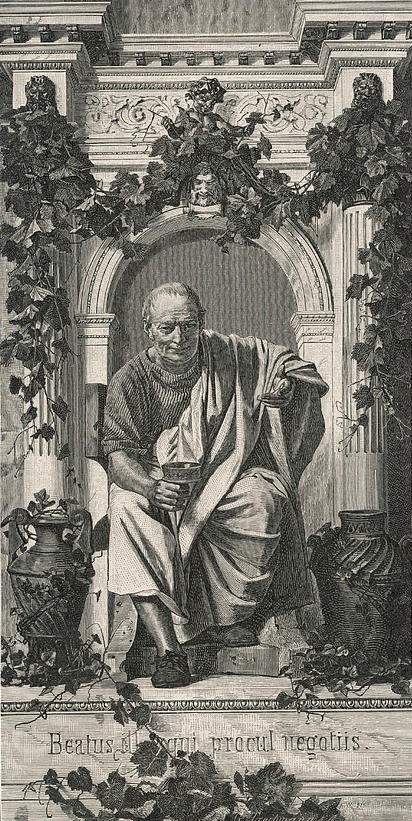
A much later imaginary portrait of Horace by Anton von Werner—not a surviving likeness from Horace’s lifetime. Wikimedia Commons, public domain.
The Sun Was a Design Load
Romans could not lower the outdoor temperature, but their better builders understood that they did not have to invite all of it indoors.
Vitruvius told architects to adapt buildings to climate. In hot regions, he recommended opening them toward the north and east. Within a Roman house, he placed winter dining rooms toward the setting sun, bedrooms and libraries toward the east, and summer dining rooms toward the north, away from the sun’s high summer path.
For spring and autumn dining rooms, he suggested an eastern exposure and keeping the windows closed until the sun had passed midday. The advice is almost two thousand years older than the phrase solar heat gain, but the load was the same.
This was not a machine. It was a collection of decisions made before anyone laid the first brick: which direction a room faced, when sunlight entered it, how many exterior surfaces it had, and whether another wall, roof, tree, or portico shaded it.
The easiest heat to remove is the heat that never enters.
Shade Did Most of the Work
In a large Roman house, an atrium opened part of the roof to the sky and directed rain into a basin called an impluvium. Farther inside, a peristyle might surround a garden with a roofed colonnade. The open center admitted light and air. The portico provided something more useful during a hot afternoon: shade.
We should not turn every Roman courtyard into a passive-cooling machine. An open court exposed to hard sun could become hot. A basin or fountain could produce some evaporative cooling nearby, especially when the air was dry, but it did not refrigerate the surrounding rooms. The result depended on geometry, shade, masonry, openings, wind, and the temperature after sunset.
Used well, those pieces worked together. Roofs and colonnades kept direct sun off walls and people. Masonry absorbed heat slowly, delaying the indoor temperature rise. Cooler night air could carry some stored heat away before the next day began.
A modern simulation of one Pompeian house suggested that occupants of that particular design could have been reasonably comfortable in summer, although they would have needed added heat in winter. A computer model cannot tell us exactly how an ancient person felt, but it supports the basic physics visible in the ruins: shade and mass could flatten the daily swing.

The atrium and rainwater basin of the House of the Vettii at Pompeii. Open courts brought light and air into the house, but their thermal performance depended on shade and the surrounding construction. Photo by Mary Harrsch/Wikimedia Commons, CC BY-SA 4.0.
Air Still Needed a Path
“Natural ventilation” can sound like a feature that comes free with a window. It does not. Air needs an opening to enter, another route to leave, and enough wind or temperature difference to move it.
Pliny the Younger’s seaside villa shows how deliberately a wealthy Roman could manage those paths. His long covered portico had windows on both sides. In fair weather they could all be opened. In strong wind, the openings on the exposed side were closed and those on the sheltered side were used instead. During summer, he wrote, the portico caught westerly winds and circulated them through the building.
Its shade moved with the sun, protecting one side in the morning and the other in the afternoon. The same structure blocked unpleasant winter winds and accepted summer air when it was useful. The building did not maintain one set condition. Its occupants operated it.
Doors, shutters, curtains, and windows were the controls. Rooms were the zones. People opened, closed, and moved between them as the sun and wind changed.
That required choices. It also required somewhere else to go.
Water Cooled People Better Than Houses
Water appears everywhere in stories about Roman cooling, sometimes with more power than the evidence gives it.
A pool, fountain, or wet surface could cool the air immediately around it through evaporation. Water was even more dependable when applied directly to the person: drinking it, washing, swimming, or stepping into the cold room and cold pool of a bathhouse. The Romans did not need to lower the temperature of an entire building to lower the temperature of a body.
For the wealthy, water could become theater. Private houses and villas had fountains, garden basins, swimming pools, and cold baths. The richest could go further. In Epigram 14.118, Martial warns a slave not to mix snow-chilled water with cheap Massilian wine because the water might cost more than the wine. Seneca complained about people mixing snow with wine or chipping ice into their drinks.
Somebody had carried that snow down from the mountains and preserved enough of it to survive the trip and the season. Every cold mouthful in August represented a long chain of mountain labor, storage, transport, and loss—and a customer rich enough to pay for what melted along the way.
Ordinary Romans had access to water, but usually not in the same way. Around the end of the first century, Rome’s water commissioner Frontinus recorded 591 public basins supplied by the aqueduct system, along with ornamental fountains, baths, and other public uses. At Pompeii, street fountains served most of the population because relatively few private houses were connected directly to the mains.
The public fountain was valuable. It was not indoor plumbing. Water carried upstairs in a jar could cool and clean the people in a room, but it could not turn the apartment into Pliny’s villa.
The Apartment Had Fewer Answers
This is where the evidence becomes less personal. Wealthy Romans wrote letters about their villas. Architects wrote instructions for patrons who could afford architects. People renting one or two rooms high in an apartment building did not leave us summer comfort reports.
The building physics still tells us something. A small room beneath a sun-struck roof, with limited openings and little opportunity for cross-ventilation, could hold heat long after the street began to cool. Cooking, lamps, bodies, and work added more. Opening a shutter might release heat, admit a breeze, admit afternoon sun, or do all three at different hours.
A tenant could use shade, water, light clothing, a hand fan, or a cooler public place. Porticoes shaded parts of the city. Public baths offered water and cold rooms. In the Colosseum, a vast fabric awning shaded spectators.
Those were real forms of relief. They were also temporary. At the end of the day, the tenant climbed back to the same room.
The rich did not possess secret laws of thermodynamics. They possessed more ways to take advantage of them: northern rooms, shaded gardens, private water, controllable windows, country estates, coastal villas, servants to move furniture and operate shutters, and enough spare space to abandon a room when it became uncomfortable.
Roman cooling was not divided between people who knew the tricks and people who did not. It was divided by who controlled the building.
Horace’s Country Air
Horace liked to present his Sabine life as modest. Compared with an emperor’s palace, perhaps it was. Compared with a rented upper room in Rome, a spring, a garden, woods, and a second place to live were an enormous environmental advantage.
His poems make that advantage feel human. He wanted relief from obligations, noise, ambition, smoke, and heat. He wanted a patch of shade where he could eat, drink, think, and write. The Roman answer to summer was never only architectural because discomfort was never only a temperature reading.
The best Roman houses could soften the heat. They could delay it, shade it, vent it, and give their owners another room when it arrived. Public water and public buildings gave many other Romans moments of relief.
When Horace sat beside his spring, the valley supplied the pieces Roman cooling needed: shade, water, moving air, and somewhere for the day’s heat to go. Back in Rome, relief was often measured in hours—where a wall cast shade, which fountain was nearest, and how long a roof would hold the day’s heat.
Next in A History of Comfort: Roman comfort consumed more than clever ideas. Part 4 will follow the wood, water, smoke, maintenance, and human labor that kept the system working—and ask who paid the real cost.
Research notes and sources
- Horace’s background, military service, pardon, clerkship, patrons, and country life: Suetonius, Life of Horace
- Horace’s desired garden, spring, and woodland: Horace, Satires 2.6
- Horace’s invitation to escape the dog-star heat in the Sabine valley: Horace, Odes 3.29
- Climate-responsive design and room orientation: Vitruvius, De architectura, Books 6.1 and 6.4
- Archaeology and thermal simulation of a Pompeian house: Rajapaksha et al., “Exploring thermal comfort in the context of historical conservation,” Architectural Science Review
- Pliny’s adjustable windows, portico shade, and summer airflow: Pliny, Letters 2.17
- Roman snow and iced drinks: Seneca, Moral Letters 78 and Martial, Epigram 14.118
- Rome’s 591 public water basins: Frontinus, The Aqueducts of Rome 78
- The role of Pompeii’s street fountains in daily public water supply: Monteleone et al., “The supply of the public lacus of Pompeii,” Archaeological and Anthropological Sciences
- Cold rooms and pools in Roman public bathing: University of Washington, “Baths & Bathing as an Ancient Roman”
- The Colosseum’s shade awning: History, “How Ancient Romans Kept the Colosseum Cool in Sweltering Heat”


No comments:
Post a Comment