
Ancarenus had to die to find a place where he could live rent-free.
His full name was Ancarenus Nothus. He was a formerly enslaved man who lived in ancient Rome and died at 43. We don’t know what he did for work or exactly where he lived. Most of what remains of him is a short inscription placed with his ashes in a shared tomb outside the city.
It says that his bones can rest now. He no longer has to worry about hunger, aching legs, or coming up with money for rent. His lodging is free forever.
It is a dark little joke, but it tells us more about ordinary Roman life than another marble statue of an emperor ever could. Rent followed this man all the way to his grave.
I read a lot, and I have a habit of following a question farther than I meant to. Lately, I started wondering how people dealt with heat and cold before there was electricity, modern equipment, or anyone to call when something quit.
Rome seemed like a good place to start. The Romans were serious builders, and some of what they built looks surprisingly familiar to anyone who works in HVAC. But they weren’t the first people to solve these problems, and the story didn’t end when their empire did. Every part of the world has its own history of keeping people warm, cool, and alive.
Every once in a while, I’m going to follow another piece of that story—one place and one system at a time. This will still be an HVAC blog. Just not always the kind of HVAC that comes with a model and serial number.
Two Romans, Two Ideas of Home
Nothus measured a home by whether he could afford to stay in it.
Pliny the Younger measured one by the direction of the afternoon wind.
Pliny was a wealthy Roman senator and writer. Around the beginning of the second century, he sent a friend a long description of his seaside villa. He explained which rooms caught the morning sun, which were protected from winter winds, and which stayed pleasant in summer because of their height and shade.
He had cold, warm, and sweating rooms, along with a heated swimming pool overlooking the sea. A colonnaded passage leading to one bedroom used built-in channels to catch and circulate hot air. Another small heating apparatus had a trapdoor that could admit or block heat.
Pliny could open windows on the sheltered side of a portico when the wind picked up. He could move to a sunny room in winter and a shaded one in summer. If one part of the house was uncomfortable, he had another part of the house.
That may have been the greatest luxury of all: choice.
Roman comfort wasn’t one invention. It was the whole building. Sun, shade, masonry, wind, water, and room placement were made to work together. Pliny had the money and space to use all of them.
Most Romans Did Not Have Heated Floors
When people talk about Roman heating, they usually jump straight to the hypocaust—the system that moved hot gases beneath raised floors and sometimes through hollow spaces in the walls.
The hypocaust was a real and clever system, common in bathhouses and also found in wealthy homes, villas, forts, and other important buildings—but it was not standard equipment in every Roman apartment.
The empire crossed climates that demanded very different answers, from the dry heat of North Africa to the wet cold of Britain. There was no single Roman home and no single Roman way of heating it.
For many ordinary people, heat came from a hearth, cooking fire, or portable brazier holding charcoal or wood. The warmth stayed close to the fire. So did the smoke and the risks of burns, bad air, and a building fire.

A bronze brazier and pot from Pompeii. Portable fire was a more realistic source of household heat for many Romans than a built-in hypocaust. Photo: Gary Todd/Wikimedia Commons, public domain.
In a rented room, the tenant couldn’t redesign the walls or decide that the bedroom ought to face the winter sun. The building was what it was. Comfort came from clothing, bedding, a small fire if one could be used, and getting through the weather.
We cannot say that Nothus owned a brazier or lived on the top floor of a crowded apartment building. His inscription doesn’t tell us that. What it does tell us is that rent and hunger were real pressures in his life. A man worried about his next housing payment was not living in Pliny’s world of spare bedrooms, private pools, and adjustable heat.
The Heat Below the Floor
The basic idea of a hypocaust was simple enough. A fire burned in a furnace beside the building. Hot combustion gases traveled beneath a heavy raised floor and, in more elaborate systems, through passages in the walls. The warmed floor and walls then radiated heat into the rooms.
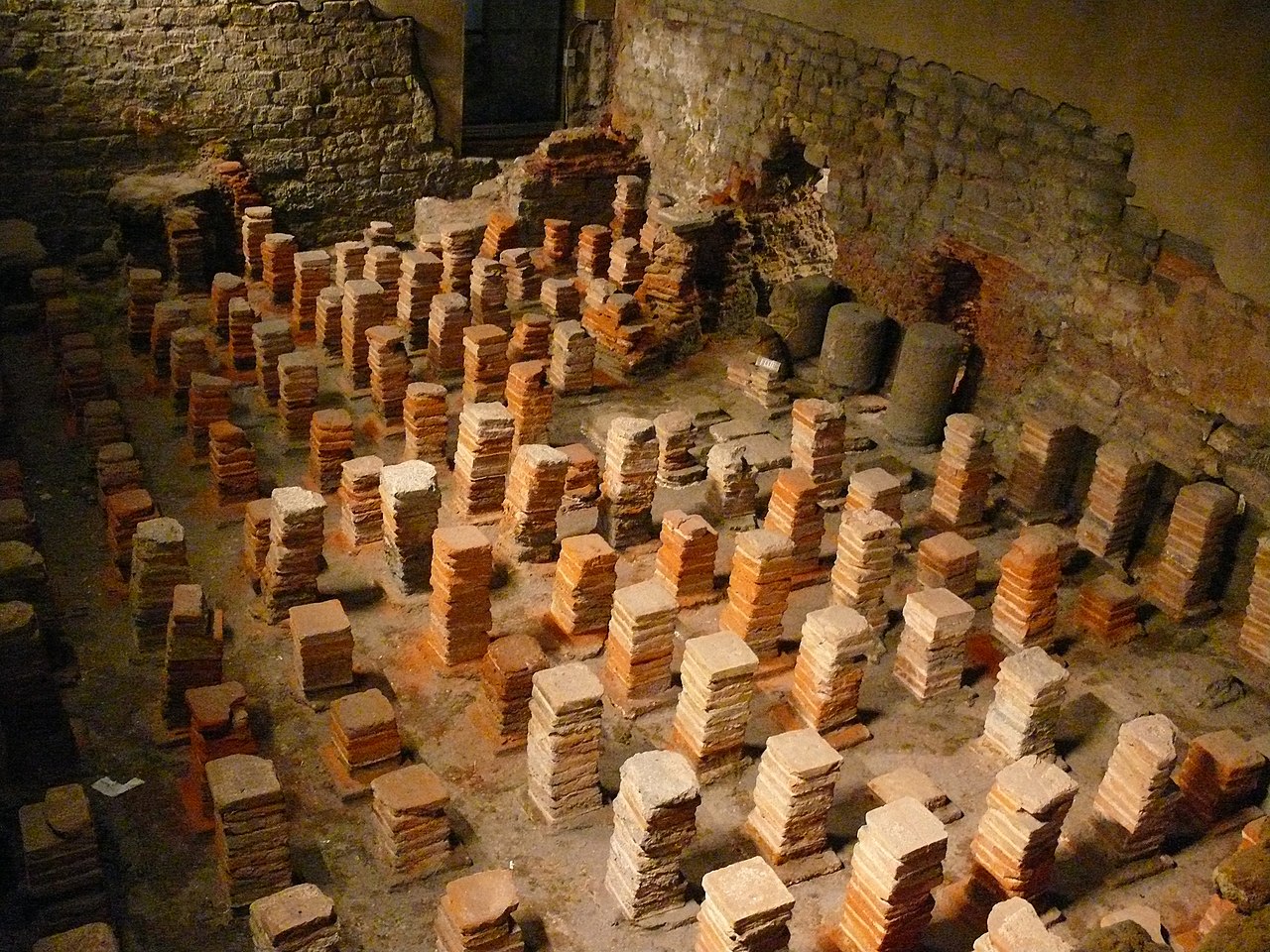
The finished floor rested on these brick pillars, leaving space underneath for hot combustion gases to move through. Photo: Ad Meskens/Wikimedia Commons, CC BY-SA 3.0.
There was no thermostat and no blower. The system depended on fire, natural draft, masonry, and time. A thick floor did not warm instantly. Somebody had to start the fire, feed it, and learn how that particular building behaved.
When I look at the remains of a hypocaust, the little brick pillars are interesting. The part I keep thinking about, though, is the person standing at the furnace.
Someone carried the fuel, cleared the ash, and dealt with a poor draft or a room that would not warm up. The people enjoying the finished space might never see any of it.
That part has not changed as much as we like to think.
What Survives of Neo
One of the people tied to this comfort was named Neo.
His grave marker was found in a burial complex belonging to the Statilii Tauri, a wealthy Roman family. The published reading of the inscription, cataloged as CIL VI 6243, is:
NEO
T. STATILI
TAVRI SER.
BALNEATOR
Expanded, it reads: Neo, Titi Statili Tauri servus, balneator. In English: “Neo, slave of Titus Statilius Taurus, bath attendant.”
A balneator was a bath attendant or manager. Neo may have overseen a private household bath. His owner’s family may instead have operated a commercial one. Historians cannot be certain, and I don’t want to turn him into a furnace tender just because it would make the story neater.
What we can say is that his job was tied to someone else’s comfort.
Pliny used paragraph after paragraph to describe the pleasures of one villa. Neo’s surviving life is essentially his name, his owner, and his occupation.
We do not know whether he liked the work, hated it, or simply did what he had to do. We don’t know whether he became free or even how old he was when he died.
Roman history tells us much more about the person walking across the warm floor than the person responsible for keeping it warm.
Public Comfort, Private Inequality
There was one place where these Roman worlds came closer together: the public bath.
For a very small entrance fee—and sometimes for free—ordinary Romans could enter buildings with warm rooms, hot rooms, cold pools, heated water, and radiant floors. Someone whose rented room had no built-in heat could temporarily use one of the most sophisticated heated buildings in the ancient world.
The bath did not erase class. A wealthy visitor could arrive with enslaved attendants carrying clothing, oils, and personal belongings. A poorer visitor had fewer choices and fewer people looking after him. The same warm room could hold both men, but they had not entered it from the same life.
Below them, the fires still had to be kept burning.
What a Warm Floor Can Tell Us
Roman engineering deserves its reputation. Its builders understood radiant heat, natural draft, solar exposure, and the value of using different rooms in different seasons.
But the system is only half the story.
Nothus left a joke about finally escaping rent. Pliny left detailed instructions for finding the most comfortable room at almost any hour. Neo left his name, the name of the man who owned him, and his job.
Three lives. Three very different relationships with comfort.
Pliny could choose the room.
Nothus had to find the rent.
Neo helped make someone else comfortable.
That is where this history really begins—not with the invention under the floor, but with the people standing above and below it.
Next in A History of Comfort: We’ll go beneath the floor and look closely at how Roman hypocaust heating worked, how it was controlled, what it consumed, and what happened when something went wrong.
Research notes and sources
- Ancarenus Nothus and CIL VI 7193a: EAGLE Epigraphy Network
- Pliny’s description of his Laurentine villa: Pliny, Letters 2.17
- Neo and Roman bath personnel: The Personnel of Private and Imperial Baths in Ancient Rome
- Neo’s inscription, CIL VI 6243 / ILS 1412: Inscriptiones Latinae Selectae
- Excavated hypocaust construction: St Albans Museums
- Roman public baths, admission, staffing, and civic oversight: Smith’s Dictionary of Greek and Roman Antiquities


No comments:
Post a Comment